Welcome!Program

Program

Preliminary Technical Program

MONDAY 31/08

Track 1Track 2Track 3Track 4Track 5
Session 1 WS Combating Drone Theft Through the use of Intelligent Jamming (Part 1) TT Electromagnetic Compatibility in Power Electronics: Emission Mechanisms, System Interactions and Mitigation Techniques (Part 1) TT Fundamentals for EMC (sponsored by IEEE EMC EdCom) (Part 1) WS New Simulation Methods and Statistical Modelling Techniques for EMC and Electromagnetics (Part 1) WS NATO E3AT AECTP 250/500 Introduction Industry Participation
☕ Coffee break
Session 2 WS Combating Drone Theft Through the use of Intelligent Jamming (Part 2) TT Electromagnetic Compatibility in Power Electronics: Emission Mechanisms, System Interactions and Mitigation Techniques (Part 2) TT Fundamentals for EMC (sponsored by IEEE EMC EdCom) (Part 2) WS New Simulation Methods and Statistical Modelling Techniques for EMC and Electromagnetics (Part 2) TT Tutorial: Tales and Trends from the Front Line: EMC Testing Pass Rates, Observed Failures, and Root Cause Analysis from 10 Years of Commercial Laboratory Operation
🍽 Lunch
Session 3 TT Electromagnetic Information Security: Practical TEMPEST Threats, Measurement Techniques, and Countermeasures (Part 1) IF Enhancing EMC Design and Validation Through Simulation-Driven Workflows (Part 1) TT Fundamentals for EMC (sponsored by IEEE EMC EdCom) (Part 3) WS New Simulation Methods and Statistical Modelling Techniques for EMC and Electromagnetics (Part 3) WS Automotive EMC (Part 1)
☕ Coffee break
Session 4 TT Electromagnetic Information Security: Practical TEMPEST Threats, Measurement Techniques, and Countermeasures (Part 2) IF Enhancing EMC Design and Validation Through Simulation-Driven Workflows (Part 2) TT Impact of Antenna Matching and Regulations on Devices TT Building Robust Systems: EMCD, Risk-Based EMC, and EM Resilience Explained WS Automotive EMC (Part 2)

TUESDAY 01/09

Track 1Track 2Track 3Track 4Track 5
Session 1 Opening & Plenary
☕ Coffee break
Session 2 SS Electromagnetic Information Security: Passive and Active Attacks (Part 1) RS Aircraft & Space Systems SS Advanced Experimental Techniques in Reverberation Chambers RS Signal & Power Integrity WS Ground Bounce in the Age of Chiplets and GaN - Emission-Aware Driver Design, Spectral Consequences, and Practical Mitigation
🍽 Lunch
Session 3 SS Electromagnetic Information Security: Passive and Active Attacks (Part 2) SS EMC in Electrification of Aircraft (Part 1) RS Reverberation Chambers (Part 1) RS Wireless Power Transfer WS Electromagnetic Compatibility of Railway Vehicles: Design, Simulation, Testing, and Engineering Practice Solutions
☕ Coffee break
Session 4 SS Electromagnetic Information Security: Passive and Active Attacks (Part 3) SS EMC in Electrification of Aircraft (Part 2) RS Reverberation Chambers (Part 2) RS Semiconductors, PCB, Electronic Packaging & Integration WS Electromagnetic Compatibility of Railway Vehicles: Design, Simulation, Testing, and Engineering Practice Solutions
Welcome Reception

WEDNESDAY 02/09

Track 1Track 2Track 3Track 4Track 5
Session 1 SS Simulation Challenges in Numerical Modelling of Complex Structures for EMC (Part 1) RS Automotive (Part 1) RS Shielding & Gasketing RS Lightning WS IEMI (Intentional Electromagnetic Interference) Risk Management for Critical Infrastructures
☕ Coffee break
Session 2 SS Simulation Challenges in Numerical Modelling of Complex Structures for EMC (Part 2) RS Automotive (Part 2) SS Breaking Barriers: The Next Frontier in Shielding (Part 1) RS ESD WS IEMI (Intentional Electromagnetic Interference) Risk Management for Critical Infrastructures
🍽 Lunch
Poster Session
Session 3 SS Simulation Challenges in Numerical Modelling of Complex Structures for EMC (Part 3) RS Power Systems, Power Quality, Power Electronics, Smart Grids (Part 1) SS Breaking Barriers: The Next Frontier in Shielding (Part 2) RS Advanced Materials for EMC WS IEMI (Intentional Electromagnetic Interference) Risk Management for Critical Infrastructures
☕ Coffee break
Session 4 SS Simulation Challenges in Numerical Modelling of Complex Structures for EMC (Part 4) RS Power Systems, Power Quality, Power Electronics, Smart Grids (Part 2) SS Breaking Barriers: The Next Frontier in Shielding (Part 3) RS Sensors for EMC WS IEMI (Intentional Electromagnetic Interference) Risk Management for Critical Infrastructures
Gala Dinner

THURSDAY 03/09

Track 1Track 2Track 3Track 4Track 5
Session 1 RS Intentional EMI, EMP, High Power Electromagnetics (Part 1) RS Filtering & Grounding (Part 1) RS EMC Measurements (Part 1) SS Electromagnetic Environment and Interference in 5G/6G Wireless Networks WS Advancing Automotive EMC: From Megatrends to Modern Test Methods (Part 1)
☕ Coffee break
Session 2 RS Intentional EMI, EMP, High Power Electromagnetics (Part 2) RS Filtering & Grounding (Part 2) RS EMC Measurements (Part 2) RS Human Exposure to EM Fields & Biological Effects WS Advancing Automotive EMC: From Megatrends to Modern Test Methods (Part 2)
🍽 Lunch
Poster Session
Session 3 RS Artificial Intelligence & Machine Learning in EMC (Part 1) RS Filtering & Grounding (Part 3) RS EMC Measurements (Part 3) RS Risk-Based EMC, EMC in Safety Applications, EM Resilience WS Advanced Methods for Reducing Measurement Uncertainty in EMC
☕ Coffee break
Session 4 RS Artificial Intelligence & Machine Learning in EMC (Part 2) SS Metrology for Low-Frequency EM Disturbances in EV Charging Systems RS Transmission Lines, Cables, Crosstalk & Coupling RS System-Level EMC WS Advanced Methods for Reducing Measurement Uncertainty in EMC

FRIDAY 04/09

Track 1Track 2Track 3Track 4Track 5
Session 1 WS You had me at "Reverb" (Part 1) WS Advances and Challenges in Active EMI Filters for Next-Generation Power Electronics (Part 1) WS EMC Challenges and Solutions for Aerospace Applications (Part 1) TT EMC in Energy and Mobility Applications (Part 1) WS Advances in EMC Test Site Validation 18-40 GHz (Part 1)
☕ Coffee break
Session 2 WS You had me at "Reverb" (Part 2) WS Advances and Challenges in Active EMI Filters for Next-Generation Power Electronics (Part 2) WS EMC Challenges and Solutions for Aerospace Applications (Part 2) TT EMC in Energy and Mobility Applications (Part 1) WS Advances in EMC Test Site Validation 18-40 GHz (Part 2)
🍽 Lunch
Session 3 WS You had me at "Reverb" (Part 3) WS EMC in Power Electronics (Part 1) WS Fundamentals and Applications of Rydberg Atom-Based Electric Field Sensors: From Metrology and Beyond (Part 1) WS Emerging Voices in EMC: Research Pitches from the ISENSE and PATTERN Doctoral Networks* (Part 1) TT Understanding Radiated Emission/Immunity EMC-Tests -Standards, Test-Sites, Calibration/Validation, Lab- (Part 1)
☕ Coffee break
Session 4 WS You had me at "Reverb" (Part 4) WS EMC in Power Electronics (Part 2) WS Fundamentals and Applications of Rydberg Atom-Based Electric Field Sensors: From Metrology and Beyond (Part 2) WS Emerging Voices in EMC: Research Pitches from the ISENSE and PATTERN Doctoral Networks* (Part 2) TT Understanding Radiated Emission/Immunity EMC-Tests -Standards, Test-Sites, Calibration/Validation, Lab- (Part 2)
RS Regular Session
SS Special Session
WS Workshop
TT Tutorial
IF Industrial Forum

Plenary Speakers

Zbynek Raida
Professor at Brno University of Technology

Zbynek Raida graduated at Brno University of Technology in 1991 (MSc) and 1994 (PhD). His academic activities comprise research and teaching at Brno University of Technology (since 1994), Université Catholique de Louvain (1996-97), Metropolitan University Prague (2015-19) and University of Defense (2021-22). His industrial experience covers wireless chips applications at NXP Semiconductors (2023-26) and SATCOM applications at URC Systems (since 2026). Professional interests are focused on applied electromagnetics, numerical modeling, optimization and applied artificial intelligence. Combining approaches together, the development of a general EMC certification procedure has been started.

Abstract title: Can AI replace EMC measurements?

Abstract: Current electromagnetic simulators allow us to crease efficient, accurate and reliable numerical models of complicated electronic systems. Thanks to precise measurements, numerical models can be calibrated and verified. In the definition space, the model can represent a real equipment with a reasonable accuracy.

The verified numerical models can replicate selected EMC tests. To cover European (ETSI), North-American (FCC), Japanese (ARIB) and Chinese (MIIT) markets with minimum measurements, requirements defined by partial standards are described by unified YAML files. A neural classifier can compare files contents, can select the most severe conditions and confront simulations with experiments. If the simulation meets the most severe conditions, then the device can pass the certification in an accredited test house with a high probability.

AI does not replace EMC tests but saves time, money and efforts.

Frank Leferink
Professor at the University of Twente & Director EMC at THALES Nederland

IEEE Fellow Frank Leferink has been with THALES in the Netherlands since 1984, where he is Director EMC and responsible for the EMC activities for radar systems and naval platforms.

He is also manager of the Network of Excellence for EMC of the THALES group.

THALES is sponsoring his part-time, full-research, professor position at the University of Twente, where Frank is holding the Chair for EMC. Fourteen PhD researchers, three assistant-professors and four post-docs are currently active in the EMC group.

Frank is Vice-President Conferences of the IEEE EMC Society and associate editor of the IEEE Transactions on EMC and the IEEE Letters on EMC Practice and Applications.

Abstract title: EMC, an important issue

Abstract: In 2018, an electrically powered transport vehicle for children, the Stint, crashed at a railway level crossing. Four children died in the accident. The driver and another child were seriously injured. The Netherlands Forensic Institute concluded that the cause of the accident was either driver error or an EMC problem.

We conducted extensive research on the Stint on behalf of the Public Prosecution Service, but were never able to publish our findings due to the ongoing criminal investigation.

Our verdict: the Stints do not meet the essential requirements of the EMC Directive (the vehicle was exempt from the Automotive Directive, this the EMC Directive is applicable). This is because the manufacturer did not perform a (mandatory) risk analysis and did not apply any of the interference suppression measures recommended by the manufacturer of the control computer. These measures include a shielded cable, a shielded housing, cable separation, filtering, and redundant speed control. None of these measures were applied. Actually, they did not even perform any analysis, nor any test. None.

Analyses revealed that there were interference-sensitive parts. With direct injection, the vehicle proved to be highly susceptible to interference. Subsequently, measurements were repeated in an anechoic chamber and a reverberation chamber. During our research, the wheels of the Stint accelerated, and sometimes suddenly rotated backwards (up to maximum speed) and then forwards again, without the direction switch or speed control being operated.

In this presentation, I will explain what was done during the research and what lessons we, as EMC specialists, should draw.

Social Events

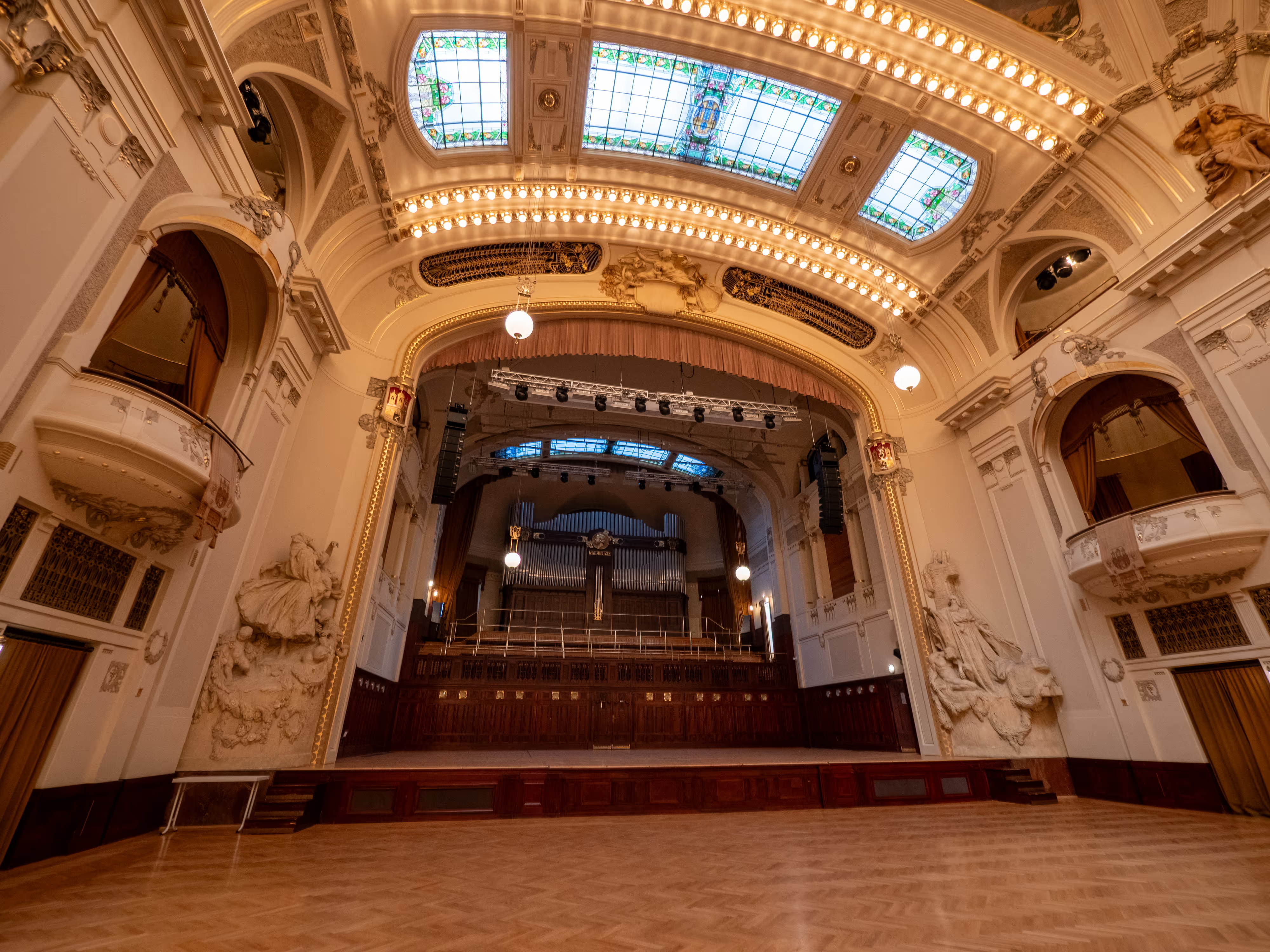
To complement the scientific program, EMC Europe 2026 offers a social program that highlights the unique atmosphere and cultural heritage of Prague, providing excellent opportunities for networking, informal discussions, and experiencing the city’s rich history. The conference will open with a welcome reception at the Prague Congress Centre, offering a relaxed setting to reconnect with colleagues and meet new attendees, and will feature a memorable gala dinner in the magnificent Smetana Hall, an iconic venue known for its stunning architecture and cultural significance, held in the middle of the conference.

MVG Welcome Reception

Welcome Reception is sponsored by 


Gala Dinner
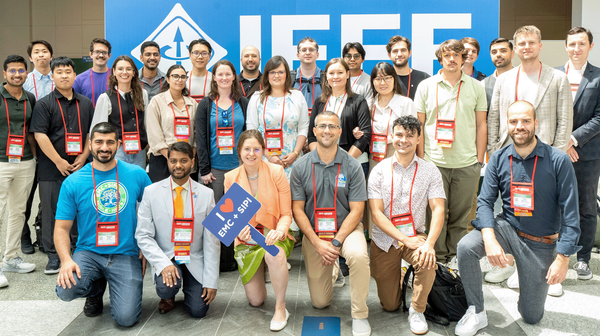
IEEE Young Professionals Event*

Join us for the IEEE Young Professionals Bowling Night at BOWLING Celnice in central Prague — bowling, billiards, darts, and table football, with food and drinks included. Meet fellow early-career EMC researchers and engineers over a bowling lane instead of a poster session. No talks, no slides — just good company and a few strikes (or gutter balls, no judgment).

*Please note that this event is organized independently and is not part of the official conference program nor arranged by the Local Organizing Committee.

Book a Meeting Room

For meetings during the conference

It is possible to book a meeting room for auxiliary meetings held during the conference. If you wish to arrange this, please fill in the form. If there are any questions, please reach out to us by email.